Wednesday, January 14, 2009

I'm Starting a New Blog

I'm going to move Turtle Island Economics to the garage for the known future, as I'm starting a new blog with Urbana.org.

It's called All Things New: A Conversation about Who We're Becoming. I hope you join me there.

Here's the introductory essay for ATN:

All Things New is about exploring our world with an attitude of big-hearted curiosity. This blog grows out of three distinct spiritual-intellectual turning points in my life.

1. Curiosity

At the age of sixteen, my father taught me the attitude of curiosity. We were in process of relocating to the United States, after several years in Switzerland. Destination? Wisconsin, a quiet state in the north-central part of the country. I was unimpressed. I had hoped for someplace exciting, as defined by an expatriate teenager whose window to America was Hollywood.

“There’s nothing to do in Wisconsin,” I told him. I imagined cheese, harsh winters, and the Green Bay Packers. None very compelling to me. “When we get to Wisconsin,” my dad told me, “you’re going to find people who live there by choice. They’re not captives. Your job is to find out why.”

With that short little instruction, my life was changed. I found tallgrass prairies and persistent ethnic neighborhoods. I found a major American regional dialect shift taking place; I found all kinds of foods I had never previously tasted. In short, I discovered that Wisconsin—and by extension the entire world—had far more treasure to it than I understood as a media-saturated adolescent.

Curiosity is no accident: it is a willingness to remain enchanted by the world, when disenchantment is the natural response. If, as Norwegian philosopher Lars Svendsen asserts in his small masterpiece A Philosophy of Boredom, boredom “contains a rejection of—or rather detestation of—God and his creation (p. 50),” curiosity is boredom’s inverse. Curiosity and faith are intertwined.

2. Truth Grasped

A few years later, I was studying at the University of Wisconsin, a large and worldly institution dedicated to “ever encourag[ing] that fearless sifting and winnowing by which alone the truth can be found” (the school’s motto). I was genuinely saddened and, well, disenchanted to discover: not all thinkers were interested in finding the truth. Many seemed more interested in critique.

Two thousand years ago a witness to the intellectual climate of Athens saw a similar situation:

All the Athenians and the foreigners who lived there spent their time doing nothing but talking about and listening to the latest ideas (Acts 17:21).

To rephrase in terms of my school, they were more interested in “sifting and winnowing” than in “finding the truth.” They were dedicated to endless, rather than fearless, sifting.

Intellectual maturity, it struck me then and now, involves fearless sifting, followed by fearless grasping of what truth can be grasped. Skepticism, though useful as a tool for sifting and winnowing, can often paralyze the soul.

3. Big-Heartedness

Again a few years later, I was on staff with InterVarsity. An aging lion of the Civil Rights Movement addressed a national staff gathering, with a message of Christian humanism. Years of digging for truth had shown me the empty foundations behind humanisms of all stripes, which I confidently shared with my team during the subsequent debriefing time.

In return I received a stunning rebuke. My team leader bluntly warned me not to “become one of those people,” those critical souls so dedicated to correct doctrine that they miss truth in disguise. She went deeper:

“You have a choice to make here. Every time you choose to criticize, you risk becoming more of a critical person.”

To say that God and God’s truth are bigger than comprehension is not to succumb to cynical relativism. No: it is to balance our search for truth with a willingness to grasp it even when it comes bundled with nonsense.

If the risk of broad curiosity is seduction by untruths, the risk of unbending insistence on orthodoxy is that of becoming an unbending soul.

A Conversation about Who We’re Becoming

Okay, so what? Here’s what I’m trying to accomplish with All Things New: I want to invite you—readers—to join me in this quest. I will unearth treasures—cultural, ecological, theological, and interdisciplinary—and try to share them with you.

I want to hear your thoughtful, big-hearted opinions, and I want you to read others’. Together we might discover something important.

I read a lot of books. I cross cultures daily, in my neighborhood and through my church. I take my kids on field trips to the park. I listen to missionaries’ stories whenever I get a chance. Whenever my toe strikes something worth sharing, I’ll let you know. Meanwhile, if you find a treasure of your own, that you want to discuss, let me know; I’ll see what I can do.

Wednesday, September 17, 2008

Yodelling is Alive


I went to a nearby town recently, to hear a yodelling concert. New Glarus, Wisconsin is a town founded a hundred seventy years ago a Swiss emigrant community. They far more than cling to old traditions: they cultivate them, and keep them alive. Here are two members of a local choir, getting ready for a concert.

Tuesday, September 09, 2008

Mobile Citizenship?


A fascinating article in Eurozine on Bulgarian migrant workers examines the ways global capitalism demands a deep rethinking of the very concept of home.

Basically, a huge percentage of Bulgarians are displaced laborers across the European Union, quite often "without papers." Their fate in many respects resembles that of undocumented Mexicans in the US: forever in danger of being deported, they end up under the control of coyotes, sometimes as near-slaves.

As illegal residents, they have a relationship to the host society that is ambiguous at best, and certainly offers no chance at integration.

Here's the question that kept returning to my mind as I was reading: to what extent are American citizens, in full possession of citizenship, thrown into the exact same cultural no-man's-land? How many condos are mere bedrooms for a transient class of professionals, whose belonging to their place begins and ends with their current job?

How many of us would suffer very little loss if our entire cities were to burn to the ground, forcing us to up and relocate?

Friday, September 05, 2008

How I Long For A Paw-Paw


I'm reading a tasty book on endangered foods of North America. It's got everything from "Tennessee Fainting Goats" to all kinds of berries, beans, and corn varieties I'd never heard of.

The authors of Renewing America's Food Traditions: Saving and Savoring the Continent's Most Endangered Foods broke North America down into ecological "nations" sharing traditional staple foods, from "Maple Syrup Nation" in the northeast, to "Bison Nation" in the plains, to most appropriately, "Acorn Nation" (California).

For each region they highlight several perfectly good foods, that have been left along the wayside for any of several reasons. Mission grapes, for instance: A type of grape grown for wine at Spanish-Californian missions. The breed suffered two setbacks, from which it barely survived. The first, of course, was California's transfer to the United States, which hastened the end of the missions, after which many were abandoned. The second was prohibition, during which period most of the remaining vines plowed under for other crops.

When California's wine industry returned, it was designed in competition with French wine. French grapes like Merlots and Chardonnays were planted. Most growers had never heard of Mission grapes, until one grower discovered feral mission grape vines in a sage-covered hillside she had bought. Apparently left to their fate a century ago, these handful of vines survived and have now been restored as a novelty wine, produced in only a few cases a year.

Meanwhile, some fruits--like Paw-Paws--are too fragile to transport in trucks and crates. I have never had a Paw-Paw, although archeologists have found paw-paw seeds among native kitchen scraps right in my neck of the woods. It's possible to grow them here, but we stick to a half-dozen varieties of apples.

There are several stories like this, and page after page I grew more amazed at how impoverished my supermarket is. There can't be more than a few dozen fruits and vegetables in the produce section rotation; or a dozen meat animals. The authors of Renewing America's Food Traditions have opened my eyes to endless new possibilities.

Beyond the joy of variety, however, lies a deeper issue: if we're ever going to survive a national interruption to our transportation network - whether in the form of terrorism or simple unaffordability (fuel prices) - it will be because our neighborhoods and surrounding counties have figured out how to feed themselves with crops uniquely suited to their conditions.

= = = = = = =
Photo Credit: Flickr user Blackstone Photography of WV


Thursday, September 04, 2008

Wednesday, September 03, 2008

Badgers are Back in Town

One of the strange aspects of living across the tracks in a college town is seeing life go on, year round, with no hint that another part of the city is alternately bustling or vacant.

It is my pleasure to announce, then, that the Badgers are back in town.


This clip accurately portrays gameday atmosphere, albeit without profane chanting, drunken staggering and puking, and broken bottles on sidewalks. Badger games are fun (although I haven't attended one in three or four years).

These tribal gathering are impressive. It is to Badger home games that alumni typically refer in their fondest memories; the home games, then, are highly significant for "Badger Nation" identification, i.e. fund-raising.

Tuesday, September 02, 2008

It shouldn't be heroic to make room for the disabled


This is an ugly man. Or was, rather. He was an Etruscan, one of the indigenous tribes of Italy, whose civilization was wiped out by the Romans.

Etruscan art is notable for its depiction of normal people, warts and all--a stark contrast to the heroic obsessions of the Romans.

The professor who taught me these things felt it important to note that a measure of a society's cruelty or kindness is its treatment of the disabled. In the case of the Etruscans, their willingness to depict ugly people suggests a similar willingness to include them in their society.

Which brings us to Sarah Palin.

Andy Crouch notes in Culture-Making that the Republican Vice-Presidential candidate's now-famous decision to keep her Down Syndrome baby is an instance of cultural leadership. In a nation where 85% of Down Syndrome babies are quietly aborted, Palin's is an expression of inclusivity.

So far, so good. But it's a creepy thought to consider that (in the media's eyes, at least), her decision is noble. In fact, if we really believe in inclusivity, tolerance and democracy, we oughtn't bat an eye about Palin's decision. It shouldn't be heroic to make room for the disabled.

The general acclaim about Palin's heroism testifies more to the hidden shame in our society of our hidden intolerance for the weak, the ugly, the disabled and the outsiders.

PHOTO CREDIT: Flickr user diffendale.

Saturday, August 30, 2008

Waste is a Spiritual Matter

Rotten Apple, credit sxc.hu user grceva
A conversation about ethanol recently took a surprisingly emotional turn. My friend, from a large Asian country never far from food emergencies, told me how wrong it feels to him when Americans waste food, or play with it, or in the case at hand, drive it.

This was refreshing even as it was urgent. Because food is life. It should be felt, not just consumed. In fact, there's something deeply human about strong feelings about wasted food.

Meanwhile, the New Republic's Vine - their environmental blog - takes a look at wasted food. As it turns out, roughly 50% of the food we humans produce gets wasted. In poor countries it's market inefficiencies (food rotting in the fields etc.); in rich countries it's too much market efficiency (Food is so cheap that we buy more than we can use and throw it away.

Thursday, August 28, 2008

Vicarious Vicariosity


My beloved FC Basel qualified for the UEFA Champions League this week. Today they were matched for the group phase against FC Barcelona, Sporting Lisbon, and Shakhtar Donetsk of Ukraine.

I've followed Basel since the 1980's, when I lived there. Back then, the team was in the Swiss division 2, so I can claim to have followed them since they were really bad.

Here is the Question: what does it mean to follow a team vicariously like this? I mean, I live in another country, never watch their games, and know no other fans.

Photo Credit: Flickr User keepthebyte

Wednesday, August 27, 2008

Manufactured Landscapes

My iPod doesn't actually come from a copper mine in Arizona. It comes from China. And when it eventually gets destroyed, a lot of it will go back to China a scrap and possibly as toxic waste.

Manufactured Landscapes is a documentary I saw recently, on DVD from the library. It's really stirring in its silent depiction of the industrial landscape of the workshop to the world, China.

Here's the trailer. I really recommend it.


Saturday, August 23, 2008

Where My iPod Comes From

Tire for Copper Mine Truck, at the Asarco viewing station, Ray, Arizona

It is sometimes difficult, in our globalized economy, to conceptualize the connectedness of our consumer products. If, for instance, our bread contains foodstuffs from a half-dozen states and three or four countries, we can be excused ignorance of truly complicated items like computers.

It was a little sobering to recently visit an enormous copper mine in Arizona. (Copper, of course, is needed for circuitry.) It's kind of hard to represent just how enormous this production was, so here are two attempts.

First, a few pictures. The first two are satelite images, screen shots from Google; the third I took from the blue shed in the background of the tire picture above:


Now, here's a panorama with my pathetic camera:


They extract miniscule amounts of copper from all this rock a few grams to the ton, I believe. So mines have to be this big to even stay in business, even at today's sky-high prices. It's the only business model that works.

I'm trying to grow beyond knee-jerk opposition to mining. We oughtn't judge mining in the Sonoran Desert under the same criteria as mining in Armenian forests, for instance.

Wednesday, August 20, 2008

Reclaiming Friendship


Andy Crouch has a new essay on culture-making.com about online social networks (scroll to August 18, because I can't find a way to link to individual articles).

[Courtesy of Andy's comment: here's the link. Thanks, Andy!]

Looking at Twitter in particular, he points out that there is a limit to interpersonal relationships people can handle: somewhere around 150. Beyond that, as he says, "our little brains get overloaded. But online social networks are not just relational tools; they're also tools for "broadcasting".

It may well be that many of the most powerful media of the next generation will have this hybrid quality—keeping us connected, in some thin but real sense, to our "real" friends, but also allowing us access to the thoughts of folks like Barack Obama. And the second group, the "broadcasters," will likely be the drivers of whatever business model eventually makes these networks sustainable.


True enough. But it's important to add one detail, important from the perspective of humanness: online friends are not identical to real friends. The difference lies in love.

Dr. Venn can help us here:


In this model, set A represents people to whom I am bound by love (broadly conceived); set B represents people to whom I am bound by online social networks. The intersect are those people I know online, and whom I love.

This is an idealized, of course: love resists facile quantification, so it's hard to know where real loyalties lie. One test, of course, is the sickness test: who will come for a visit weeks and months into a sickness? Survivors of such illnesses often testify of surprise about who came and who didn't.

The other source of the confusion is cultural, not technological: as a culture of individualists, we really have no handle on loyal friendship. We are lonely, we don't know how to have friends, and we don't know how to be friends.

So when Myspace et al. use the human word friend to denote a morally neutral technological relationship, our confusion only grows. Adolescents, of course, who are in the process of that most traumatic of splits--away from parents--are doubly confused here.

Then there is the cross-cultural. Americans as a rule are far more prepared to use the word friend than people of more communal cultures. I have, for instance, found old Swiss classmates of mine on Facebook, people with whom I spent years in the same room. But I wouldn't dare add them as friends, because they weren't friends, in the Swiss sense: they weren't people who'd cross the world to be by my deathbed, or visa-versa. And so they remain unconnected to my Facebook account.

But since we live in a hybrid culture, and since Facebook and Myspace remain thoroughly American, I am also friends with people I don't even know, or in the case of Johnny Cash's Myspace account, people who are dead. (I share the latter relationship with 302,000 people, around the population of Pittsburgh.)

Culture-Makers, to use Andy Crouch's term, have low-hanging fruit here: Friendship, real friendship, is a lost art, but one which has strong support in scripture and church tradition. Culture-Makers concerned about the individualism in American culture could do worse than look at Reclaiming Friendship, to steal the title of Ajith Fernando's out-of-print, pre-Myspace gem.

Tuesday, August 19, 2008

Sense of a Place that Never Really Was

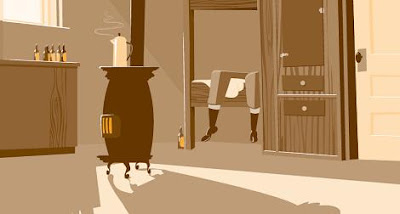
Pirated Image from Pascal Blanchet's White Rapids. I appeal to fair use, because I'm recommending the book because of the artwork.
I’m not big on graphic novels, because the stories too often play second-fiddle to less-than-compelling artwork. Sometimes I read about such and such a story being “deep” or “sweeping” and I end up feeling like I’ve eaten unseasoned soup.

This is one of the wonderful exceptions. White Rapids, by Pascal Blanchet. It's the story of a company town in remote northern Quebec, built around a hydro-electric dam. The company provided amenities resembling mid-century North American middle-class life, in exchange for the hardship of living in utter isolation [map] with a few hundred other employees and families.

It's a short book, with fanciful art deco drawings conveying a Utopian nostalgia, something I normally find quite off-putting. But the Never-Never-Land effect works here, in part because it feels like outlandish propaganda by a loaded and megalomaniac company, one willing to impose an impossible town on an unforgiving landscape, at great expense, for the even greater profits that would follow.

In light of that history, Utopianism is the only possible design choice, like Las Vegas in the desert.

Here's the artist's website.

Saturday, August 16, 2008

Not all racial boorishness is racism.

Racism is alive and dangerous, from genocide on down to exclusion. It's an issue of the heart, and needs to be dealt with as such.

That's why I'm not all that upset about the Spanish basketball team's "slant-eye" photo-op. Making fun of somebody's facial features is just provincial. It's something that's funny when you're a child, and is no longer interesting when you grow up.

But when we use words like racist where stupid would suffice, we risk dilluting the importance of addressing racism.

Consider this, from Feyenoord (Rotterdam, Netherlands) fans, chanting against Ajax of Amsterdam (a team associated with Jews, albeit with no Jews on the roster:

Hamas, Hamas, the Jews into the Gas


It's around 0:25 of this clip. the Dutch is "hamas, hamas, joden aan het gas":


Comments below the clip (in Dutch) argue the finer point that they hate Ajax Jews (the largely gentile fans), not Jews in general.

Ian Buruma attended one of these matches while writing Murder in Amsterdam: Liberal Europe, Islam, and the Limits of Tolerence:

"F__ing Jews!" [Feyenoord fans] went again every time an Ajax player touched the ball, even if he was a black Surinamese. "Cancer Jew!" they shouted when the blond referee from the northern province of Friesland whistled for a Feyenoord foul.

And then I heard it for the first time, a sinister hissing sound from hundreds, maybe thousands, of beer-flecked mouths. I didn't know what it meant, until [Buruma's friend] Hans explained it. The sound got louder: the sound of escaping gas.

In Budapest soccer stadiums, players of a side owned by a Jewish businessman were greeted by rival supporters shouting: "The trains to Auschwitz are ready!" In the Olympic Stadium of Amsterdam, the fans were a touch more inventive.


In light of such creepy populist passion, it seems trite to accuse the Spaniards of racism. Racism is deadly, and shouldn't by dilluted by association with stupidity.

Friday, August 15, 2008

One Week's Haul


One Week's Haul
Originally uploaded by Paul Grant
Becca and I have been members of a local CSA for several years, and this summer's been one of the best.

Community-Supported Agriculture (CSA), for newcomers, is simply pre-buying membership in a farm's produce, in exchange for weekly baskets during the growing season.

Basically, you buy into the risks and bounty of a given farmer's year, and you commit to a relationship with that producer.

CSAs put the eater and the grower in close contact. We have to speak to one another on a weekly basis, something that rarely occurs at the supermarket. The system also helps the local economy in big ways and small: together we're helping our region, our county, become a little closer to agriculturally self-sufficient.

If, as Homeland Security is always saying, our national food supply is at risk for bio-terror attack, the best solution is to diversify the supply.

Meanwhile, there's an added benefit to a CSA: the food is way fresher, and tastier. So, for example: this week we got okra, chiles, corn, tomatoes, cucumbers, squash, apples, peppers, onions, and a melon.

The produce is seasonal, of course. Earlier it was lettuce, garlic and strawberries; later it'll be acorn squash, potatoes and the like.

This is significant. Eating is, as Wendell Berry put it, an agricultural act. It is profoundly humbling to understand just how connected we are to the work of growing food in fields.
In the abstraction of our daily lives from the real world of gaining our life from the dirt, we are impoverished where we needn't be, and in the ease with which we fill our bellies, courtesy of our convenience culture, we are robbed of the very humility that can help us retain our sense of human finiteness.

To visit, then, with Mr. Pierce, as he asks about my baby, while packing my food--this brings about way more than entertainment and tasty tomatoes. It is goodness (broadly conceived).


Thursday, August 14, 2008

Segregation as euphemism

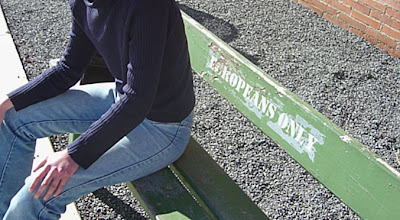
Europeans only bench at Apartheid museum in South Africa; credit sxc.hu user pixelstar
Segregation simply means keeping things apart. But a word so burdened with history means nothing simply.

Segregation (along with its South African cousin apartheid) has a long track record as a prescription (not just a de-scription) for racial life in America: black and white were to be kept apart by force of the law.

But a thought has crossed my mind in recent days: segregation is a euphemism. That is, it's a delicate way of saying something far worse.

Segregation is a euphemism for isolation. Keeping people apart was not really the goal; after all, even in Bull Connor's country black and white were in constant contact. Somebody needed to cook and do laundry and change diapers, after all.

No, it was never about keeping people separate. It was always about keeping people in their place.

And while segregationists were able to distort scripture to justify their purposes (i.e. don't marry Canaanites), isolation can't be justified with scripture.

Isolation gets uglier the more you look at it. It's dehumanizing, degrading and destructive.

That's why segregation is shameful. That's why isolationists needed to hide behind the euphemism of segregation.

= = =

[photo credit: sxc.hu user pixelstar

Tuesday, August 12, 2008

I'm reading about headscarves

I'm now reading a terrific book called Why the French Don't Like Headscarves: Religion, the State, and Public Space.

This is by American anthropologist John Bowen, who was living in France for a few years while the French were debating (and passing) a law banning Muslim headscarves in the public schools.

Far more than a political story, Bowen explains the French political/social worldview, which proves incredibly useful. I've been following this story for years, and having it explained in worldview terms helps immensely.

For instance: Bowen notes that the French tend to view social freedoms as coming from, and being guaranteed by, the state. Any weakening of the state will ultimately threaten human rights.

Since Muslims believe that Islam contains ultimate truth, most believe their religion needs to be lived out in all areas of life, not just in private.

But the French tend to view publicly assertive religion in terms of their lengthy struggle with the Catholic Church. For a century after the revolution, the Church insisted on "integrism", or the Church's dominance in all of life.

The French state prevailed by the creation of laïcité, usually translated as secularism. All public life is to be secular, according to this line of thought, because only a secular public space can guarantee freedom of thought and conscience.

When a Muslim girl wears a scarf--a veil as it's called--in school, the guardians of laïcité feel this is an assertion of Islam's superiority over the secular space.

Friday, August 08, 2008

Wisconsin Citrus


Despite its harsh winters, Madison (and the surrounding Dane County) is one of the United States' food capitals. Between year-round farmers markets, seasonal ones in almost every town, dozens of community gardens, abundant Community Supported Agriculture offerings, farmer-owned cooperatives, and an environment teeming with fish, turkeys, and other cuddly edibles, this is one of the country's regions best prepared to survive a national disruption in commodity food supply.


But some foods simply can't be grown here. Like Lemons, and Coffee. It's too cool in the summer and the season is too short.


Sumac LemonadeSo what's a place-conscious person to do? Find stand-ins, of course. This summer I've been making "lemonade" from sumac berries—something I'd never done before, and which frankly always sounds just a little too granola for me. But it's cheap (free), and fun, so why not? And it's good. Sort of citrus-y tart, and beautifully red.

Meanwhile, the Isthmus (a local paper) is profiling a berry farmer who's experimenting with seaberries as a legit substitute for oranges.


[Farmer] Secher is thinking big. He's not looking to create niche products, but a new fruit market "we can mainstream regionally—one that's sustainable environmentally, economically and socially." He dreams of regional processing and marketing and the infrastructure to make it happen.


This isn't necessarily starry-eyed thinking. Kiwifruit, for example, was a niche crop, closely associated with New Zealand (but native to China) until the mid-twentieth century, before it gained institutional support from big bad USDA. The USDA is now looking at Lingonberries and others.


Ecologically speaking, we should put a lot more work into feeding ourselves at a local level. There are countless foods we could be eating—far more than the twenty or thirty in the supermarket rotation. Most are either too widespread to be marketable (Dandelions, for example, make great salad), or too fragile to be industrially processed or transportable on a national basis (Paw-Paws, for example).

Saturday, August 02, 2008

Introducing ...

Welcome, little boy.
His name is Silas.

Friday, August 01, 2008

Boomers Approaching, Hat in Hand

Yours for only $291,000: The Winnebago VectraA new study shows what any fool could have told us: the majority of the Baby Boomer generation will outlive their savings.

In other words, we their children and grandchildren will have to pay for them.

The Baby Boomers, long ago nicknamed the "Me Generation," the people who brought us Woodstock and Yuppies, are now eligible for AARP membership. Millions of them are woefully unprepared for the challenge of old age.

Somebody will have to care for them, and that somebody will be whoever's in their prime productive years. In fact, loving elderly Boomers may well be the main thing we do with our next forty years. It will be an awesome responsibility, and an opportunity, too: we have before us the chance to reshape the history of generational relationships.

Adults throughout history have taken care of their parents and children simultaneously. What sets our generation apart is that we will have more old people than children to care for. Taking care of the Baby Boomers will be the greatest moral challenge our generation faces—how we do it will be the measure of our character.


= = =


Photo Credit: Winnebago Industries