Thursday, May 03, 2007

The Corrupt Judge


This is the most selfish story I've heard in a long time.

A judge in Washington, D.C. has filed suit against his Korean dry-cleaners for $65 million for a lost pair of pants - a pair of pants that was found and returned a week late.

Judge Roy Pearson is on all kinds of civic groups - a regular good citizen and neighbor, right? Here's where he has been a volunteer:

  • Columbia Heights Youth Club, the nation's first racially integrated youth club.

  • Fort Lincoln Civic Association, Inc. Fort Lincoln is a leafy enclave in Washington DC - a community planned as racially integrated in the 1960s.

  • Black Seeds, Inc -- a nonprofit that has sponsored the "African Heritage Family Festival".

  • the DC chapter of the National Council of Black Lawyers. This is an outfit whose mission is

"to serve as the legal arm of the movement for Black Liberation, to protect human rights, to achieve self-determination of Africa and African Communities in the Diaspora and to work in coalition to assist in ending oppression of all peoples."

See a pattern here? Judge Pearson is a man of great power (as a judge). He is also a community leader for civil rights, racial justice, and ending oppression.

But compassion for the people who wash his dirty clothes? Out of the question. I really don't want to make this a racial thing, because the power dynamic seems to be the main issue here, but I have to wonder if the corrupt judge would be suing if the cleaners were, say, black.

Thursday, April 26, 2007

Mr. Pierce's Veggies


It's time for the South Side farmers market again!

While I can't stand Madison's downtown market, which combines a uniquely Madison admixture of hippies and yuppies, both of whom are quite elitist in their own ways, the South Side market consists mostly of farmer Robert Pierce and a revolving cast of others.

I love it, and Mr. Pierce's veggies are the best anywhere.

Thursday, March 29, 2007

Army retreats from Indian Territory


A mothballed army ammunition plant near Madison is getting returned to the land's original owners, the Ho-Chunk Indians. The deal marks a beginning of a lengthy restoration process, as the rich prairie along the Wisconsin river is currently mostly dead.

Before the buffalo can roam once again (the tribe's long-term goal), the soil will have to get restored. And that is slow work: it might not be finished for another century or so.

Monday, March 26, 2007

Waving the French flag is unbefitting a Frenchman.

The French presidential elections are upon us, and in a tight three-way race, things are beginning to get caustic.

So we have two contrasting appeals to national identity—a fascinating quarrel. Ségolène Royal, a Socialist from a military family, who has made a career advocating for the environment and small-scale local farmers, suggested the French people fly the French flag.

Not a particularly risky thing to say, even among elites who consider themselves above flag-waving. Still, she elicited a stinging rebuke from the third of the three main candidates.

François Bayrou, a practicing Catholic of the more socially conservative UDF party, who’s got the most to lose at this stage in the election, saw low-hanging fruit in Royal’s banal appeal.

“I love France, and I am well at home in my country, but this obsession [with flags]—and a president who makes declarations of good and evil—such things don’t belong in my country. Such things are American.” (rough translation and emphasis mine.)[1]

In other words, waving the French flag is unbefitting a Frenchman.

For what it’s worth, Bayrou's campaign website features video from Youtube, which belongs to that national enemy of France, Google.


[1] "J'aime beaucoup la France, je suis bien dans mon pays, mais cette obsession qui fait qu'il va falloir avoir des drapeaux et les mettre à la fenêtre tel jour, et que la présidente de la République va vous dire ce qui est bien et ce qui est mal, ça ne ressemble pas à mon pays, a déclaré devant la presse le candidat UDF à la présidentielle. Tout ça, c'est la société américaine."

Thursday, September 07, 2006

Wisconsin in Zimbabwe


School Children
Originally uploaded by Obi-Akpere, ObiAkpere.
What do you know?

I was browsing Flickr, and found this classroom in Zimbabwe. Bucky Badger, front and center.

How did he get there? Probably a clothing merchant bought a crate of used clothes, which were originally dropped off at Goodwill.

Thursday, August 24, 2006

Problem Solved


Problem_Solved
Originally uploaded by Paul Grant.

There has been a bit of a buzz lately about T-shirts advocating domestic violence and relationship aggression. Before they disappeared altogether, I ripped a bunch of them and uploaded them to my Xanga photo gallery.

I do this to keep this transgression in front of Kohl's face. (Transgression is the word: this shirt is intentionally cool, and cool is inherently transgressive.) If we let Kohl's merely sweep these shirts under the rug, the conversation won't take place.

Kids will wear shirts like this precisely because of the reaction they get from adults. That's why we're adults: our job is to shape them into healthy, mature people, not perpetrators. So we can censor their jokes.

Kohl's is free to print whatever they want, of course, but - as Pamela Paul noted in her brilliant book Pornified - there is a third way between censorship and eternal tolerance. It's censure. It's shame. We need to shame those adults who tell kids it's ok to throw people out the window.

We can't uncool domestic violence. It's too late for that. We can only uncool ourselves. We can't uncool our children. We can only set models of compassion for them.

Tuesday, August 22, 2006

Neighbors and Food

I go back and forth on the issue of access to quality food in the inner cities. On the one hand, the grocery stores are a scandal. Copp's for instance: there's a filthy store on S. Park Street in Madison, with low-grade produce and flickering lights. Two miles to the south, there's a beautiful store full of high quality, low-pesticide food. The difference is the neighborhood. Copp's should be ashamed of themselves.

On the other hand, they have a business to run; why should they have to carry quality food that people don't buy? Food is more than a supply issue. If the south side demanded good food, it would materialize.

Here's a secret: the demand is there, and so is the supply. There are several small neighborhood grocery stores all along south Madison. But they are owned by - gasp - immigrant families. Yue Wah (below, bottom right) is a huge store, with great produce, albeit largely Asian and Latin American. Marimar (top right) is smaller, but much more familiar to mainstream American tastes. They've also got quality produce, including the best Avocados in town. Sundays they make their own corn tortillas from scratch. Then there's this other store - the name escapes me - on Fish Hatchery road (below, on the left). The owners are Vietnamese and the food is fresh.

map loading...


In all three cases, when I shop there, the owners are helpful and friendly, but there are no other whites or blacks in the stores. So whose fault is it if quality food is hard to come by?

It's the fault of the prejudiced shoppers, who won't condescend to crossing cultures when they shop. To be fair, there are occasional language barriers in the stores. But I chafe every time someone complains that there is no good food to be bought on the South side. It's anti-immigrant prejudice - the notion that there is nothing for me in a store with foreign-looking products - that is killing us.

Thursday, August 17, 2006

Hip Hop: The Polka of Today

Club Majestic, the focus of all the troubles
Club Majestic
Originally uploaded by Gordon_McMullan.

Madison the white city isn't going down without a fight. It's not really a hip hop thing; it's not really about race, either, even though the debate has been largely held on racial grounds.

No, it's a class thing, and it's been going on for well over a century. They did it to the Germans first, by cracking down on their peaceful - but noisy and raucous - parties.

Today our city fathers are busy trying to ban hip hop nightclubs because of "violence," which translates as people being having fights in the street outside a hip hop event. Never mind that people have fights outside UW-Badger events every single day. A few years ago a bar banned athletic wear, but chose to enforce it along obviously cultural lines, allowing Wisconsin varsity garb full access.

Hip Hop's crime is bad taste (in the judgement of Fred Mohs and the Downtown Madison inc. crowd), taste as adjudged according to the aesthetic minimalist standards that built the Overture center.

It would be an entirely avoidable waste if we (as a city) hold this debate without remembering the previous rounds in this fight. David Mollenhoff's incredible book of Madison history tells the story. In the 1870s, hordes of Germans settled in Madison, and unsettled the "native" city fathers.

The Germans' main crime was being ethnic. They held enormous beer parties in Brittingham Park on Sundays, parties that tended - like Club Majestic's hip hop nights - to spill into the surrounding neighborhood. Worse, the Germans favored raucous, low-class polka music. The kind with tubas that can be heard for blocks around.

Madison's big cheeses know that upscale, wine-sampling, art-buying tastes don't stand a chance in the free-market of arts and culture, so they need to enforce the standards with the support of government.

If hip hop fans started wearing sedate clothes, started driving quiet imports, and managed their disputes with lawyers instead of fists, the city fathers would be all smiles.

Sunday, August 13, 2006

Sweet is Kitchy?


New Glarus Hotel
Originally uploaded by mizidymizark.

The Wisconsin State Journal published a positive but snarky review of New Glarus' Chalet Landhaus Inn restaurant the other day, and dropped a few cultural mistakes into article.

Author Chris Martell summed up his review with "Great service and food in a homey, if kitschy, environment." I've been to that restaurant many times, and I've never found a trace of kitch anywhere. So what is it that Martell found?

Authenticity.

Switzerland is a modern country completely at peace with its peasant heritage, its "Volkstum". Go into any cable car, restaurant or tavern in the mountains, and they'll be playing Alpine music over the stereo. It's not kitch; it's a celebration of heritage.

Trust me: Here is a TV ad for Switzerland, from YouTube. It ran in Germany during the buildup to the world cup. The idea was to suggest to soccer-weary German women a vacation in Switzerland during the tournament.

They play with all the national stereotypes, including the alpine music in question. It's modern, folksy, sweet and a little racy all at once.

[A rough translation of the voiceover is "Dear Women, consider spending your World Cup-summer in a place where the men care less about soccer - and more about you.]

The Chalet Landhaus Inn plays the same music. It's just like in Switzerland.

In fact, the entire hotel is uncannily authentic - not only the old-fashioned volkstum stuff, but the minimalist DESIGNsuisse architecture of the rooms. Alas, Chris Martell misunderstood the sweetness of "yodeling on the sound system" as phony heartland kitch.

Tuesday, August 08, 2006

The Killer's Caught; the Burglars Aren't

The suspect is under arrest in the Cypress Street murder. Looks like a standard domestic dispute resulting in a decidedly non-standard double murder. As in, a jilted lover killed his girlfriend and the man she was with, who happened to live next door.

The suspect has already served time for homicide in the early eighties.

While it's a relief to know that 1. They caught the guy, and 2. it was a relational issue (meaning it doesn't affect others), there is another problem going on: a series of break-ins and robberies on my street, including my next-door neighbor and his neighbor.

We've lived on this street for three years, but last night we locked the windows for the first time in a long time.

Monday, August 07, 2006

Neighborhood Murder

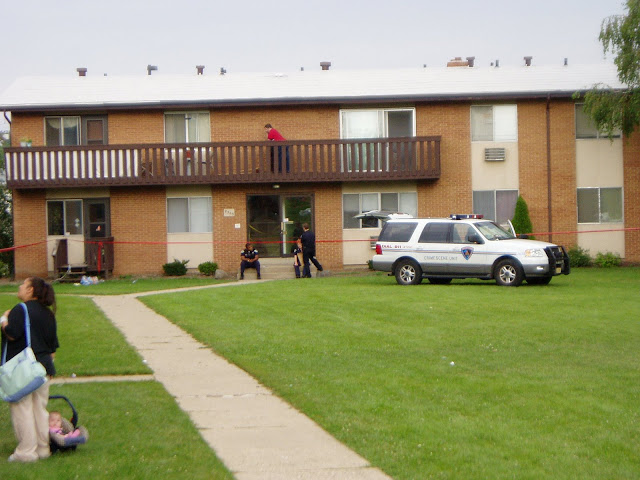
There was a murder a block from my house this weekend. A double murder, acutally. Stabbing.

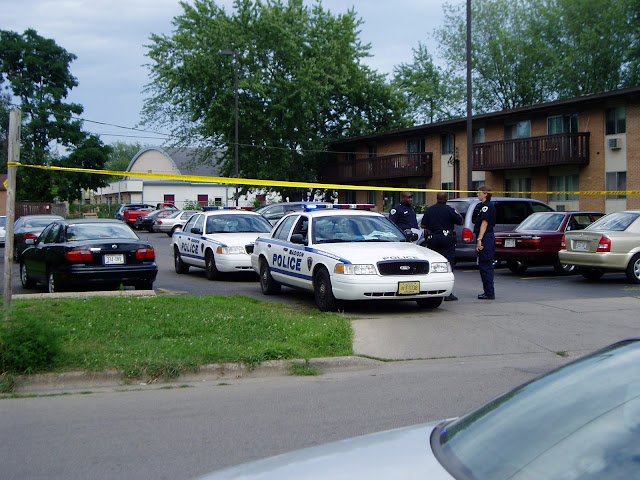
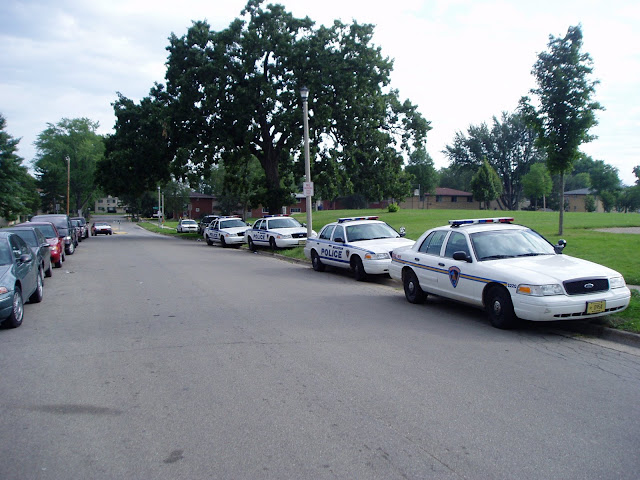
It was a huge crime scene, with 23 cop cars present. (The Wisconsin State Journal counted "at least a dozen police vehicles".)

As I was standing around gawking with others, two people from the DA office came by, explained some of the details, and offered us counseling services.

The victims included a fifty-one year old white man and an unidentified black woman. Police are looking for a "person of interest".


map loading...


Here are a few more pictures ...


Looking South on Cypress, across the street from the crime scene

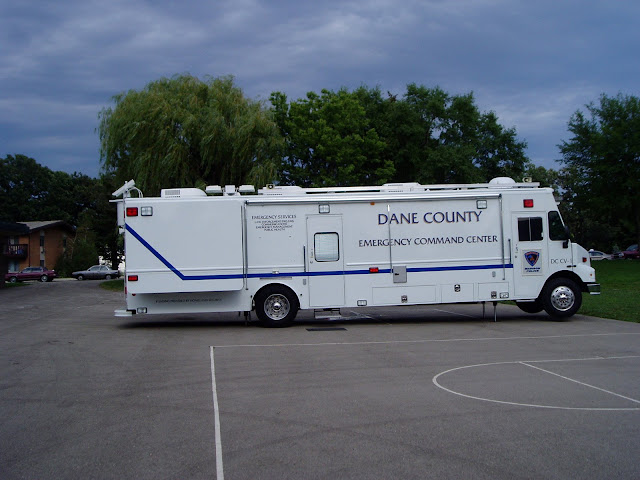
Above, here are some of the cop cars. Below, the "Dane County Emergency Command Center." Didn't know we had one. Fortunately, it says, right there on the bottom left, that it was paid for by Homeland Security. In other words, "we didn't spend your local tax dollars on this Winnebago."


Update: I'm trying out a new feature called Filmloop. Click here to see all these pictures in a scrolling bar.

Friday, August 04, 2006

Sweet Land

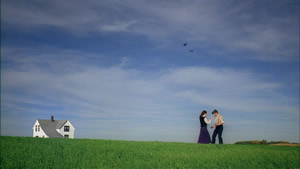
A recent movie I've seen better expresses the sadness of immigration and the meaning of land than anything I've ever seen: Sweet Land.

This is about a mail-order bride from Norway, who arrives in early twentieth-century Minnesota to meet her husband, a Norwegian immigrant farmer.

Olaf picks up Inge at the train station, and like so many other young couples right after World War 1, they head straight for the chapel. But as they are getting married - having spoken only a few words with each other - the young bride is found wanting. Inge is a German, not a Norwegian.

And we (Norway and the US alike) are at war with Germany. Worse, she is a member of the Socialist party.

Sweet Land tells the story of this young couple, as they build an international love in a land strange to both of them. It is a story of making a home.

The 1920 plot is set as a flashback; the surrounding story takes place today, after Inge's death at an old age. Her grandson Lars - an entirely assimilated American - has to make a decision about his land. It's worth millions of dollars as a suburban subdivision. How should Lars honor Inge and Olaf with this land, this home?

I was enchanted for days after seeing the film. Unfortunately, it's on the film-festival circuit, and is not slated for broader release. I emailed Ali Selim, the filmmaker, who replied that the DVD might be out by Christmas. Sigh. Until then, if you're interested in the story, it's loosely based on a short story by Will Weaver called A Gravestone Made of Wheat. The story is slightly different than the movie, but equally moving.

Wednesday, August 02, 2006

Homeowner. Non-Native.

As a homeowner in Madison, what responsibilities do I have, relative to the original, Ho-Chunk inhabitants of the area? Don't know. But the State of Wisconsin thinks I own the land.

That's not a real problem. The solution to complex evils (like the European conquest of North America and the subsequent settlement here by Europe's outcasts and peasants) is rarely to run away from the problem, but to meet it head-on.

Accordingly, I think I will try to find out as much of the history of this plot of land and the surrounding neighborhood as possible.

Tuesday, August 01, 2006

Happy Birthday, Switzerland

It's the first of August, and we all know what that means, eh? Swiss Confederation Day!

Some of my fondest memories of childhood relate to August 1 - bonfires, singing, fireworks, lanterns and festivities and more.

Representatives of three alpine counties gathered on a secluded meadow on this day in 1291 - that's right, 700 years ago - to declare independence from the Habsburg Austrians.

August 1 always makes me a little sentimental like July 4 doesn't. I'm not patriotic for Switzerland, mostly because I'm not Swiss. But having spent much of my childhood there, and because much of my heart is wrapped up in Switzerland, I feel secretly joyful on this day.

Monday, July 31, 2006

A Downpour out our Front Door

Our house is in a flash-flood district. While we're on a hill, and are thus not susceptible to flooding in our own right, runoff from our neighborhood flows past our house into a nearby creek. Here's our street, during a recent storm.


Here's what happens moments later, when several square blocks of impermeable surfaces start flowing downstream. A standing wave in the middle of the street!

Sunday, July 30, 2006

Tomato!

My tomatoes have arrived--the first ones at least. Now is the sweetest time of the year. Is there anything better? Perhaps growing one's own, from seed. We cheated this year, going with plants from the garden store. Our neighbor still has no fruit, and he started from seed. Posted by Picasa

Friday, July 28, 2006

A Nearly-Missed Opportunity

There’s an intentionality about meeting neighbors. It can be a drag, sometimes. Becca and I decided long ago that we need to live, on a daily level, the way we want to be. Annie Dillard said it, in The Writing Life:
“How we spend our days is, of course, how we live our lives.”


In other words, how we approach our moments with our neighbors is how we live our lives. Do we want to be rushed, hurried and on our own? We have to make that choice over and over again.


For example: Yesterday we walked to the library. It was going to be a short trip, because we needed to be back in a half hour. We wanted to do some internet business on a faster-than-dialup connection.


Alas, two hundred yards from the library, we ran into a neighbor, an older man from the Philippines, who told us two years ago to have a baby, because “Baby makes you
Happy!”


It was obvious that he wanted to more than say hello. He talked at us about his grandchildren. Then about his mortgage. Then about something else. I was anxiously thinking of the time slipping away, the time I could be spending uploading a document.


But Becca and I had already had this conversation: this is the kind of people we want to be – accessible to others, not too hurried or important to linger, love, and laugh. We didn’t need to discuss, even as Bert droned on and on: It was more important for us to talk with him than to go accomplish our petty errand.


In hindsight, we didn't miss the chance to upload a high-resolution photo. Rather, we almost missed an opportunity to become the kind of neighbors we want to be. Fortunately, we survived.


It’s hard. Because we didn’t actually get to do what we wanted. We had to turn around and go home. We were a little frustrated, but we knew that neighbors are made, not born. Without planning, precious opportunities to live life will pass us by. Posted by Picasa

Tuesday, July 25, 2006

Meeting the Neighbors


So Becca and I bought a house, and had a baby.

That's why I haven't posted here lately.

But I am now on a mission to meet my neighbors, so posting will begin shortly as I tell our stories ...

Thursday, September 01, 2005

New Orleans and Old Naples

It’s not Katrina’s fault. New Orleans survived the hurricane relatively intact. The current disaster is manmade. More later. But first an historical note on ecological disasters.

Southern Italy is notoriously poor and underdeveloped. Many communities are continually fighting epidemics of yesteryear, like cholera. Global trade is a rumor; wealth creation is a bizarre notion.

Southern Italy, also called the Mezzogiorno, is one of Europe’s backwaters, but unlike other underdeveloped districts of the EU, not much is changing. Ireland, Europe’s erstwhile poorhouse, is now among the richest countries in the world. Spain, a dictatorship until 1978 (the same year as the Iranian Revolution), is now prosperous but for a few quarters. Even Greece successfully pulled off the 2004 Olympics.

The Mezzogiorno, on the other hand remains poor, corrupt, and isolated. It shouldn’t be this way: the South of Italy stands in the middle of the Mediterranean Sea, and is thus immediately at the nexus between the Middle East and Europe. Unfortunately, history is once again bypassing southern Italy. Today the real crossroads of the Middle East and Europe are London, Paris and Rotterdam.

It all started long ago, as Roman infrastructures failed at the beginning of the dark ages. When coal became harder to get, the urbanites of the southern Italian peninsula stripped bare the hillside forests for fuel. The land could no longer absorb winter’s heavy rains, and flashfloods washed the soil away.

Without soil, crop failures ensued, which in turn led to famines and emigration. Since the educated and the strong are the ones most likely to avail themselves of the option to relocate, the poor and the weak were left behind – albeit without control of the land, as feudal princes became absentee landlords.

Without natural or cultural wealth, the world began to detour around the Mezzogiorno. Down through the centuries countless movements have arisen to uplift the Italian South, but few projects touch the heart of the problem: the Mezzogiorno’s poverty is in the first instance an ecological matter, paired with a political failure to reform. But that doesn’t solve the immediate problem: when people are hungry, undereducated and poor, planting trees doesn’t help. They need food. But in the long run, restoration may be the only option that will take.

New Orleans is our Mezzogiorno: a man-made ecological disaster with humanitarian consequences. The entire city is below sea level because the land is sinking. Sitting astride the mouth of North America’s largest river, New Orleans should naturally be flooded nearly every year.

The floods play an important role in the ecosystem, dumping thousands of tons of silt onto the land. New Orleans below ground is a living geological history of the middle of the United States.

Unfortunately, our society has not learned to live with floods, preferring instead to fight them off with dams and dikes. The Mississippi River’s deposits of silt are currently washing out into the Gulf of Mexico. And the city, absent continual deposits of new soil, is gradually settling. Currently a few feet below sea level and several feet below the level of the Mississippi River, the city has been unsustainable for quite some time. This problem has not been a secret.

Hurricane Katrina came and went on Monday morning. It caused a lot of wind damage, but the storm surge was not as bad as it could have been. Monday night the city breathed a sigh of relief. New Orleans had been spared; Biloxi had been hit harder.

Relief was short-lived, however, as the storm surge on the ocean overwhelmed New Orleans’ pumps early Tuesday. No longer able to keep Lake Pontchartrain (actually, a bay of the Gulf of Mexico) on out of the city, the levee gave way, flooding those parts of the city lying below sea level.

Entire neighborhoods are now submerged. Currently close to a half million are homeless, and the situation is getting worse. Hurricane Katrina will get the blame for overwhelming the levees, but the real culprits for the flooding are the very same levees: the walls keeping the sea out also allow the land to sink further below sea level. This was not a natural disaster, but a human disaster and a natural correction.

The only sustainable solution for New Orleans is to learn to become a water city like Venice, or to relocate entirely. If it doesn’t happen now, it will happen later – after more loss of life. But just like in Southern Italy, when people are drowning, it doesn’t help anyone to talk about the valuable two inches of silt the city is getting. Ultimately, man-made or not, this is a human disaster. And just like in medieval Italy, the poor will bear the brunt of the cost, while the rich and educated will simply move tohigher ground.

Tuesday, July 26, 2005

Home Sweet Construction

We've been out of house and home for a month now, because of a botched remodelling job to the upstairs apartment. The project ultimately engulfed the entire building, sending us into hotels.

The contractors have lied to us repeatedly about the duration of the project - basically promising work they had no intention of doing, simply because telling us what they thought we wanted to hear would get us out of their hair. It didn't work, because that's not how we operate.

But the project has also given us a taste of what the poor go through on a regular basis. The poor cannot appeal to an authority, because the entire system is in place to protect the propertied, not the unpropertied. The poor are often in poor health, because they can't access healthy food. We found the same - when you simply can't access a refrigerator, or a kitchen, you are stuck with the high-chemical pre-packaged foods available at the 24/7 convenience store. Such food also costs more.

Overall, this last month has been an education in how it feels to be helpless and without rights. We haven't truly been helpless, and we haven't truly been poor, but our eyes have been opened.