Showing posts with label cities. Show all posts

Wednesday, July 23, 2008

Highways are Rivers

man-made river
The current oil crisis has cities all over the country thinking about mass transit. But some of our basic transportation problems won't be solved by quick solutions. Not that streetcars are cheap, but they're a lot cheaper than solving the underlying problem: our transportation infrastructure is built around cars. And highways are rivers: they can't be crossed, except by expensive bridges.

Urban transportation projects, starting in the fifties, focused on the automobile above all other forms of transit. Specifically, on how to quickly and efficiently move cars from the suburbs into city centers.

Poor neighborhoods tended to get in the way. David Hilfiker points out in his book Urban Injustice: How Ghettos HappenBook Cover: Urban Injustice by David Hilfiker:

As a network of superhighways meant to link the country together was blasted through cities, poor black areas were, not surprisingly, the first choices for disruption. Either an area would be razed and its former inhabitants removed, or a highway would be placed so as to create a physical boundary between the black ghetto and other areas of the city, further isolating its inhabitants (p. 8).


If we're really going to break our addiction to oil (as President Bush calls it), we're going to need to redesign our urban infrastructure, a multi-decade project.


Sorry, Al Gore, while your plan for energy independence is grand, energy independence can only be achieved by efficient consumption (not just generation), which in turn requires a fundamental rethinking of urban planning. We're in this for the long haul, no pun intended.

Sunday, July 20, 2008

Reverse White Flight?


I'm going to be chewing on this article from the Wall Street Journal for a few days. "The End of White Flight" reports on the return of middle-class whites to the urban centers of America, after a half-century of flight to the suburbs.

What interests me most, of course, were the cultural conflicts reported in the story, such as white parent demands the PTA stop selling ice cream (for diabetes). More importantly, the churches:

Old inner-city white churches are reviving after years of decline, while black churches are following their parishioners out to the burbs. One black church in Washington D.C. is looking to hire a white intern to reach the new neighbors.

Obviously this is anecdotal. But I must point out: 99% of interracial outreach by the American church is done by black churches. That's how, 11 years ago, I became a member of my (majority-black) church.

There's another element here: As African Americans flee the cities, the poorest of the poor African Americans are left behind, and what was a race matter becomes a class matter.

Elsewehere I've seen predictions of exurbs becoming the ghettos of the future, as gas prices make living way out of town decreasingly desireable.


[Photo Credit: Flickr User Boyznberry]

Sunday, June 01, 2008

Cities Are Good for the Environment

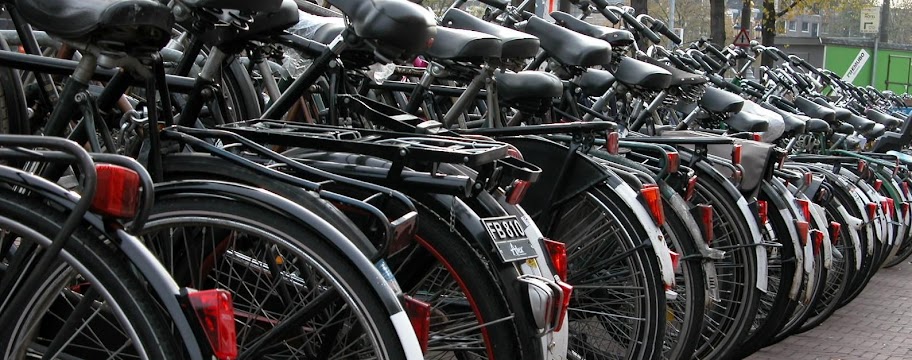
The Dutch like to bike. But it's flat there.

This shouldn't come as a surprise, but cities are efficient. That's why we built cities in the first place, thousands of years ago. Cities require far fewer resources per person.

Still, much of the environmental movement remains fixated on "nature," and for a variety of reasons—Jeffersonian individualism, puritan suspicion of urban decadence, etc.

It's been a matter of some joy for me to see the American evangelical church discover the environment. These are, in many respects, my people, and it's good to see needed change.

Still, my people, by and large, have bought into the contempt for urban life so characteristic of the American soul. The trouble is, almost no American lives a truly rural life: even those of us who live in small towns or exurbs drive long distances, for the purpose of accessing urban amenities. (Like stores, workplaces, entertainment etc.) Basically, we're long-distance city-dwellers.

What we need is a change in expectations. We need to learn to love cities.