Friday, August 08, 2008

Wisconsin Citrus


Despite its harsh winters, Madison (and the surrounding Dane County) is one of the United States' food capitals. Between year-round farmers markets, seasonal ones in almost every town, dozens of community gardens, abundant Community Supported Agriculture offerings, farmer-owned cooperatives, and an environment teeming with fish, turkeys, and other cuddly edibles, this is one of the country's regions best prepared to survive a national disruption in commodity food supply.


But some foods simply can't be grown here. Like Lemons, and Coffee. It's too cool in the summer and the season is too short.


Sumac LemonadeSo what's a place-conscious person to do? Find stand-ins, of course. This summer I've been making "lemonade" from sumac berries—something I'd never done before, and which frankly always sounds just a little too granola for me. But it's cheap (free), and fun, so why not? And it's good. Sort of citrus-y tart, and beautifully red.

Meanwhile, the Isthmus (a local paper) is profiling a berry farmer who's experimenting with seaberries as a legit substitute for oranges.


[Farmer] Secher is thinking big. He's not looking to create niche products, but a new fruit market "we can mainstream regionally—one that's sustainable environmentally, economically and socially." He dreams of regional processing and marketing and the infrastructure to make it happen.


This isn't necessarily starry-eyed thinking. Kiwifruit, for example, was a niche crop, closely associated with New Zealand (but native to China) until the mid-twentieth century, before it gained institutional support from big bad USDA. The USDA is now looking at Lingonberries and others.


Ecologically speaking, we should put a lot more work into feeding ourselves at a local level. There are countless foods we could be eating—far more than the twenty or thirty in the supermarket rotation. Most are either too widespread to be marketable (Dandelions, for example, make great salad), or too fragile to be industrially processed or transportable on a national basis (Paw-Paws, for example).

Saturday, August 02, 2008

Introducing ...

Welcome, little boy.
His name is Silas.

Friday, August 01, 2008

Boomers Approaching, Hat in Hand

Yours for only $291,000: The Winnebago VectraA new study shows what any fool could have told us: the majority of the Baby Boomer generation will outlive their savings.

In other words, we their children and grandchildren will have to pay for them.

The Baby Boomers, long ago nicknamed the "Me Generation," the people who brought us Woodstock and Yuppies, are now eligible for AARP membership. Millions of them are woefully unprepared for the challenge of old age.

Somebody will have to care for them, and that somebody will be whoever's in their prime productive years. In fact, loving elderly Boomers may well be the main thing we do with our next forty years. It will be an awesome responsibility, and an opportunity, too: we have before us the chance to reshape the history of generational relationships.

Adults throughout history have taken care of their parents and children simultaneously. What sets our generation apart is that we will have more old people than children to care for. Taking care of the Baby Boomers will be the greatest moral challenge our generation faces—how we do it will be the measure of our character.


= = =


Photo Credit: Winnebago Industries

Wednesday, July 23, 2008

Highways are Rivers

man-made river
The current oil crisis has cities all over the country thinking about mass transit. But some of our basic transportation problems won't be solved by quick solutions. Not that streetcars are cheap, but they're a lot cheaper than solving the underlying problem: our transportation infrastructure is built around cars. And highways are rivers: they can't be crossed, except by expensive bridges.

Urban transportation projects, starting in the fifties, focused on the automobile above all other forms of transit. Specifically, on how to quickly and efficiently move cars from the suburbs into city centers.

Poor neighborhoods tended to get in the way. David Hilfiker points out in his book Urban Injustice: How Ghettos HappenBook Cover: Urban Injustice by David Hilfiker:

As a network of superhighways meant to link the country together was blasted through cities, poor black areas were, not surprisingly, the first choices for disruption. Either an area would be razed and its former inhabitants removed, or a highway would be placed so as to create a physical boundary between the black ghetto and other areas of the city, further isolating its inhabitants (p. 8).


If we're really going to break our addiction to oil (as President Bush calls it), we're going to need to redesign our urban infrastructure, a multi-decade project.


Sorry, Al Gore, while your plan for energy independence is grand, energy independence can only be achieved by efficient consumption (not just generation), which in turn requires a fundamental rethinking of urban planning. We're in this for the long haul, no pun intended.

Sunday, July 20, 2008

Reverse White Flight?


I'm going to be chewing on this article from the Wall Street Journal for a few days. "The End of White Flight" reports on the return of middle-class whites to the urban centers of America, after a half-century of flight to the suburbs.

What interests me most, of course, were the cultural conflicts reported in the story, such as white parent demands the PTA stop selling ice cream (for diabetes). More importantly, the churches:

Old inner-city white churches are reviving after years of decline, while black churches are following their parishioners out to the burbs. One black church in Washington D.C. is looking to hire a white intern to reach the new neighbors.

Obviously this is anecdotal. But I must point out: 99% of interracial outreach by the American church is done by black churches. That's how, 11 years ago, I became a member of my (majority-black) church.

There's another element here: As African Americans flee the cities, the poorest of the poor African Americans are left behind, and what was a race matter becomes a class matter.

Elsewehere I've seen predictions of exurbs becoming the ghettos of the future, as gas prices make living way out of town decreasingly desireable.


[Photo Credit: Flickr User Boyznberry]

Wednesday, July 16, 2008

Who's Your (Caveman) Daddy?


Nothing quite like loving your hometown. DNA testing has connected two rural German men to a 3,000 year old caveman, whose bones were dug up on the hill outside the village.

In other words, in 3,000 years (i.e. 500 years before Buddha or Socrates), these people haven't moved beyond the village. Puts a whole new meaning to the concept of roots.

It also brings to mind the verse from ancient Chinese philosopher Lao Tzu (who, incidentally, was several centuries younger than that lineage in Germany):

Let [people] be content with their own homes, and delight in the customs that they cherish.

Although the next country is close enough that they can hear their roosters crowing and dogs barking, they are content never to visit each other all of the days of their lives.


photo credit: Flickr user Andrea Pi

Friday, July 11, 2008

Spirit Dance

Here's an album I've been listening to not quite constantly this week: Bill Miller's Spirit Dance. (iTunes has song previews)

I've been a Bill Miller fan for several years. He's a folk singer from Wisconsin (currently Nashville, of course) who has blended his Native American musical skills with the mainstream American singer-songwriter folk style.

His songs are at once heartbreakingly real and powerfully hopeful, as he manages to look hard and long at the poverty and hardships of reservation life through the lens of Christian hope at its concrete best.

More importantly, he consistently manages to create a meaningful sense of place in his music. The songs are never wishy-washy, even as they're often fictional. They're in "paper mill towns" and along "reservation roads", on "sacred ground".

Monday, July 07, 2008

Nobody's Hands Are Unbloodied

The Blood of Peasants, or more masochistic European navel-gazing?
The German arts media have been in a tizzy this year (summary, in English) over European architects' "collaboration" with non-democratic regimes--especially China, and especially around next month's Olympic Games.

The main question is of the political meaning of art: does building for a totalitarian regime lend legitimacy to said regime? The jury is out on the matter, at least in part because of China's non-pariah status in the business world--and architecture belongs as much to business as to art.

A bigger problem, in my eyes, is the question of ambiguous guilt. We all sense that our hands are bloodied by virtue of being in this world, yet we can't discern why, or a way out.

The resultant Puritanism of the secular left is the main reason why America by and large hasn't joined the progressive movement: there's more guilt there than you can shake a stick at, and no hope for salvation (see obsessive carbon-counting).

Europe (European cultural leaders at least) is much more sold on ambiguous guilt, which is why Architecture finds itself in this debate.

I don't have an opinion about the answer: where is the boundary between engagement with a totalitarian regime and endorsement of it? I don't know. But my sense is that the answer doesn't lie anywhere on that axis.

Photo Credit Flickr User Theo W L Jones

Saturday, July 05, 2008

Window on Our Ongoing Segregation


I was at first surprised, and had to rewind. It came during a podcast I enjoy—which will remain unnamed—targeted at young leaders in the evangelical church. The moderator asked the audience to email in responses to this question:

“How many of your evangelical friends are truly considering, or have already stated, ‘I'm going to vote for [Obama]’ --versus McCain? How many of your evangelical, Christ-follower friends are saying, ‘I’m not going to vote at all’?”

The fact that this question is asked makes one thing obvious: The black church is not on the radar screen here.

Nine out of ten African Americans are planning on voting for Obama. Since far more than 10% of African Americans would consider themselves “Christ-followers”, it's safe to say that a runaway majority of the black church is voting for him.

But the question tells us that we still live in different worlds. And since a large chunk of my life straddles this divide, it makes me sad—and makes me feel a little homeless.

Please note: I’m not calling these people racist. I’m merely noting that if we—as a church—were in real communion with each other, we wouldn’t wonder if “Christ followers” were voting for Obama. We’d just understand that the church has not made up its mind about the presidential vote.

Photo Credit: Flickr User PhotoMuse!

Thursday, July 03, 2008

Revolutionary Roadkill


chow down to start the revolution!


Leave it to the counterculture to glamorize scavenging.

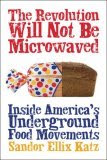
The Revolution Will Not Be MicrowavedI've just finished a most engrossing book, The Revolution Will Not Be Microwaved: Inside America's Underground Food Movements. It was a lot of fun, reading about unpasteurized cheese, organic farming, and the slow food movement.

Then the chapter on "Feral Foraging". Author Sandor Ellix Katz profiles some former vegans who've taken to eating roadkill--not as an act of desperation, but as counterculture. One he quotes as redefining roadkill:


"Transforming dishonored victims of the petroleum age into food which nourishes, and clothing which warms."

Victims of the petroleum age! And you thought you were a progressive. These guys are way ahead. If they don't die first.

Photo Credit: marta rattlesnacks, from Flickr


Saturday, June 07, 2008

Sustainable Swiss Soccer


The world’s third-largest sports event is underway: Euro 08, Europe’s tournament of national soccer teams [cue Europop Soundtrack].

Alongside hooligan-control and Spice-Girl appearances, co-hosts Switzerland and Austria have put sustainable development at the center of their strategic outcomes—as defined on three levels: ecology, economy and society.

Basically, the hosts want to be better off for having held the tournament. This is by no means an obvious goal: Glendale, Arizona lost $2.2 million on this year’s Super Bowl. Massive sports tournaments are basically one-time events, capable of permanently reshaping entire landscapes.

The Alpine hosts’ great insight is that one-time events take place in locations with histories and futures—natural and human—and that events of this variety are only worthwhile in the short run if they’re worthwhile in the long run.

What's really needed here is a new global standard for measuring cost and benefit (like the Genuine Progress Indicator) that can help us count more than money, and the Swiss and Austrians deserve some praise for bringing us a little closer to that goal.

[photo credit: Flickr user 'Host City Salzburg']

Wednesday, June 04, 2008

Life Imitates Telenovelas


The more you watch Brazilian telenovelas, the fewer children you have.

This according to an amazing working paper (pdf), brought to my attention by my favorite blog, Salon's How the World Works.

The gist of it is that Brazilian soap operas, over a period of forty years, have consistently starred female characters with one or fewer children—far fewer than the Brazilian norm (see table below, taken from the paper).

Here's where it gets interesting. The researchers—Eliana La Ferrara, Alberto Chong, and Suzanne Duryea—then look at the relationship between novella-watching and child-bearing. Since Brazil in this period was wiring the hinterlands, they can map a difference between regions which received a TV signal and those which didn't.

In regions with the signal, the more someone watches those glamorous, single-child soaps, the fewer children she will have. They also can trace a huge incidence in children being named after the stars of the soaps.

No great surprise there: In the US, Aiden (Sex and the City character) has become the 27th most popular boy's name.

Sunday, June 01, 2008

Cities Are Good for the Environment

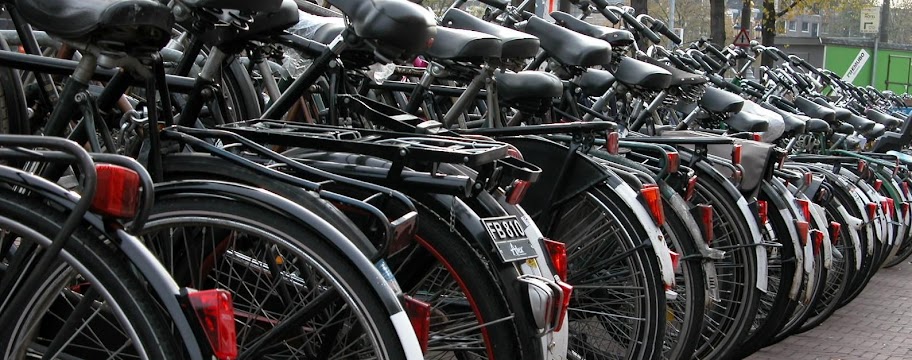
The Dutch like to bike. But it's flat there.

This shouldn't come as a surprise, but cities are efficient. That's why we built cities in the first place, thousands of years ago. Cities require far fewer resources per person.

Still, much of the environmental movement remains fixated on "nature," and for a variety of reasons—Jeffersonian individualism, puritan suspicion of urban decadence, etc.

It's been a matter of some joy for me to see the American evangelical church discover the environment. These are, in many respects, my people, and it's good to see needed change.

Still, my people, by and large, have bought into the contempt for urban life so characteristic of the American soul. The trouble is, almost no American lives a truly rural life: even those of us who live in small towns or exurbs drive long distances, for the purpose of accessing urban amenities. (Like stores, workplaces, entertainment etc.) Basically, we're long-distance city-dwellers.

What we need is a change in expectations. We need to learn to love cities.

Friday, May 16, 2008

Al Jazeera talks to Farmer Jim

You know biofuels are a force to be reckoned with when the world’s media start turning up in the rural Midwest. Record-breaking global corn prices are responsible for the attention, and this mostly because rich countries have taken to driving our food in the form of ethanol.

Al Jazeera talks to Illinois farmer Jim Robbins, and connects the dots to the Chicago Mercantile Exchange, where global commodity prices are set:


Not to be outdone, France 24 talks to farmers in Indiana. This segment is worth watching, if for no other reason than the sneering reporter’s accent:


Both segments highlight short-term market fluctuations driven by long-term changes in the world. Farmer Jim says:

“We’re going to need these high prices to continue, because our input costs … are going to go up, and that’s going to catch up with us.”


In other words, this is an economic bubble—froth on the sides of our transition away from fossil fuels. As France 24 points out,

“Ethanol … may only be a transitional fuel; even if the whole of the US were covered with corn fields, it would not produce enough ethanol to replace oil.”

Saturday, May 10, 2008

Jeremiah and Me

The Reverend Jeremiah Wright and I have a lot in common.

We’re both by nature eggheads and idealists, who’d rather talk ecclesiology than politics, and who’d rather take action than work the machines of law.

But here’s one difference: when duty called, he joined the marines, and served his country with distinction.

I, on the other hand, didn’t lift a finger. Still, his patriotism is questioned, mine is not.

Courtesy of Wikipedia, here is Wright, tending to his president:

Sunday, April 20, 2008

Where My Computer Comes From

I just got back from a week in Arizona with my Dad. Along the highway to Tucson, we drove past this copper mine:


It's a simple reminder that technology is not as clean as it feels. But our demand for copper (to run our computers, phones and laptops) makes it profitable to tear up land at this scale.

Wednesday, February 13, 2008

Obama used to party here

I was not part of this 20,000. No, I was part of the overflow crowd stuck in the adjacent practice facility.

We stood in line for an hour and a half -- it was in the single digits, with the wind whipping snow into our faces, before being told that homeland security wouldn't be letting us in to the main arena. Alas.

On the plus side, Obama poked his head into the overflow room before his speech, and was a little more personal:

"I love Madison. Back when I was a community organizer in Chicago, before I went to law school, I used to come up here for some R & R. I can't tell you what we did, but I love Madison."

Tuesday, February 12, 2008

Coming to Madison


College Park Rally
Originally uploaded by Barack Obama

The fever is certainly catching in Madison, with a rally for tonight at the Kohl Center. I am planning on going, although I've heard people are standing in line all day to get in. Not today, for me, at least.

This guy is the real deal, though. I've followed his work on the Senate's Foreign Relations Committee.

Still, I'm a little unhappy at how little the environment features in this campaign so far. And nobody seems to be talking about the dollar policy.

Thursday, February 07, 2008

Nine Springs Creek after a big storm

We got more than a foot of snow yesterday. I went snowshoeing this morning.

Tuesday, February 05, 2008

A great winter so far

This is the first solid winter we've had in several years. So on a beautiful January day, we went snowshoeing in Governor Dodge State Park.

Felt a little wierd about driving 40 miles to enjoy nature. That's a new sensation, but we've really cut back, what with $3 a gallon.

I guess we're getting 8 inches tonight, so I might be able to do this in the UW Arboretum, which is about 400 yards from our house.